
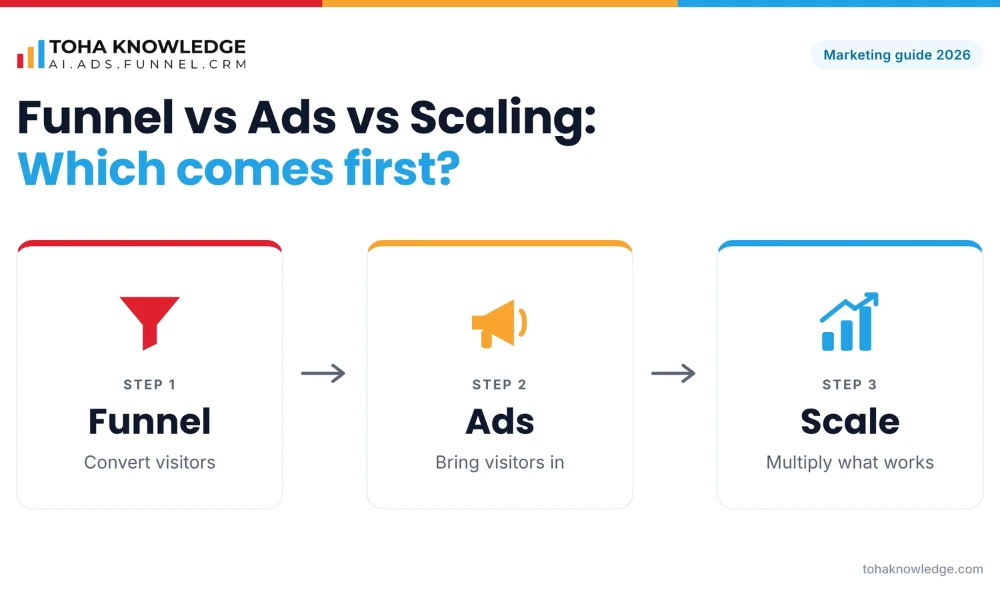
Build the funnel first, use ads to test it, and scale only when your cost per customer stays below break-even on enough sales to trust the number. Ads bring people in, the funnel turns them into customers, and scaling multiplies what already works. Do them out of order and you pay more for the same results.
Most business owners treat this as a choice: fix the website, buy more ads, or push the budget up. It isn’t a choice. It’s a sequence. This guide gives you the numbers that tell you which step you’re on, a worked dollar example, a 30-day test plan, and a table that finds the leak in your funnel in five minutes.
Key takeaways
- A funnel turns visitors into customers. Ads bring visitors in. Scaling means spending more on what already works.
- The right order is funnel → ads → scaling. Each step depends on the one before it.
- Scale only when your cost per customer has stayed below break-even long enough, and across enough sales, to trust it.
- The biggest leak is usually slow follow-up, not the ad.
- Don’t stop at the sale. Repeat customers, reviews and referrals lower what each new customer really costs you.
What are a funnel, ads scaling?
What is a marketing funnel? A funnel is the step-by-step path a stranger takes to become a paying customer. It includes everything after someone first notices you: the page they land on, the offer, the form or call, your follow-up and the sale. Many people enter at the top and fewer come out as customers at the bottom.
Example: a homeowner sees your post → visits your page → books a free inspection → gets a quote → hires you → leaves a review.
What are ads? Ads are paid placements on platforms like Google, Facebook, Instagram or TikTok that show your message to people you choose. Ads don’t make the sale. Their only job is to bring the right people into your funnel.
Example: you pay Google $3 each time someone searching “kitchen remodel near me” clicks your ad.
What is scaling? Scaling means increasing your ad spend or reach to win more customers while each customer stays profitable. Spending more is not scaling if every new customer costs more than they’re worth.
Example: your ads bring customers at $500 each and a customer is worth $1,000 to you, so you raise the budget step by step and watch that the cost stays under $1,000.
They aren’t three options to pick from. Ads fill the funnel, the funnel converts, and scaling grows what’s proven.
Funnel vs ads vs scaling at a glance
| Funnel | Ads | Scaling | |
| What it is | The path from first click to paying (and returning) customer | Paid traffic that puts your offer in front of the right people | Spending more while cost per customer stays profitable |
| Main job | Convert attention into leads, sales and repeat business | Fill the funnel with qualified visitors | Multiply proven results |
| Numbers to watch | Landing page conversion rate, close rate, repeat rate | Cost per lead (CPL), cost per customer (CPA) | CPA and ROAS as budget rises |
| Order | First | Second | Last |
| Move on when | Real visitors convert and leads get answered fast | CPA stays below break-even on enough sales to trust it | Your team can handle more leads without slowing down |
Think of it as plumbing. The funnel is the pipe, ads are the water and scaling is the pressure. Turn up the pressure on a leaky pipe and you get a bigger leak, not more water where you need it.
Why the order matters (and what goes wrong when you skip it)
Most people who click an ad are not ready to buy that day. If your only plan is “show an ad, hope they buy,” you pay for 100 clicks, sell to a handful of people and lose the rest for good.
Traffic source matters too. Someone searching “emergency plumber near me” is ready now; someone scrolling Instagram is not. That’s why search traffic usually converts better than social traffic. Social ads need a funnel that follows up over days. Search ads need a page that closes fast.
This is why the order is funnel, ads, scale:
- Without a funnel, ads send paid traffic to a page that can’t convert it, and leads nobody follows up.
- Without ads (or another traffic source), a great funnel sits empty and you can’t prove it works.
- Scaling before both work simply multiplies the losses. More spend on a broken system makes the break bigger.
Step 1: Build a funnel that converts
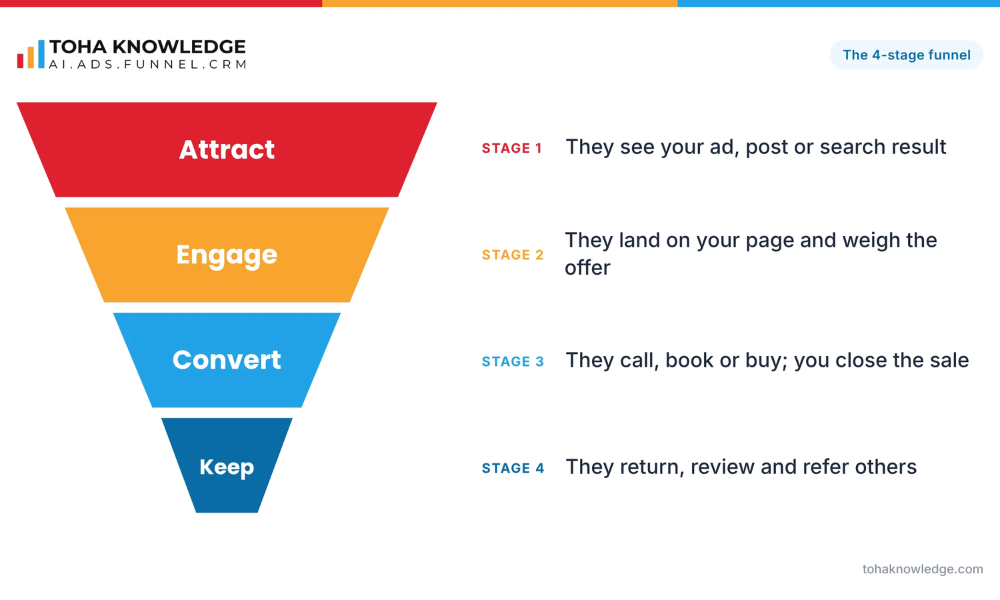
A funnel is not a piece of software. It’s the full journey a stranger takes to become a repeat customer. This guide uses one simple four-stage model:
- Attract: they see your ad, post, video or search result.
- Engage: they land on your page and consider your offer.
- Convert: they call, book or buy, and your team closes the sale.
- Keep: they come back, leave a review and refer others.
The five parts every funnel needs
- One clear offer for one specific buyer. “Free roof inspection in 48 hours” beats “quality roofing services.”
- A dedicated landing page with one call to action. Your homepage has a menu, a blog and ten other exits. A landing page has one job, so remove every link that doesn’t serve it.
- A low-friction capture step: a short form, click-to-call or a booking calendar.
- Instant follow-up: an automated text and email within a minute, then a call. Automation means it happens at 10 PM too.
- A CRM that tracks each lead from first click to paid invoice, and back again for repeat work.
What “good” looks like
Unbounce’s 2024 Conversion Benchmark Report analyzed more than 41,000 landing pages and found a median conversion rate of 6.6% across industries. Your industry’s number will differ, so look it up in the same report.
Use the median as a reference point, not a hard floor. A high-intent search campaign landing well below it is a red flag. A cold social campaign can sit lower and still be profitable if follow-up turns those leads into sales.
Funnel go/no-go: move to Step 2 when your page converts within reach of your industry benchmark, every lead gets an instant automated reply, and a person calls within five minutes during business hours.
Step 2: Use ads to test, not to grow (yet)
Ads buy attention. They can’t fix a vague offer, a slow page or a missed callback. Your first ad budget has one job: prove that paid strangers become customers at a cost you can afford.
Prospecting vs retargeting
- Prospecting ads reach cold audiences who have never heard of you. Judge them on cost per click and cost per lead.
- Retargeting ads reach people who visited your site or engaged with you. Judge them on cost per booked call or sale.
Start simple: get one strong prospecting campaign working before you build layers of retargeting. No amount of nurturing saves a weak opening ad.
The learning phase and your minimum test budget
On Meta (Facebook and Instagram), an ad set stays in the learning phase until it gets about 50 optimization events within 7 days of its last significant edit, according to Meta’s Business Help Center. Results are usually less stable and often more expensive during that time.
That gives you a planning rule for Meta: minimum weekly test budget per ad set = your target cost per result × 50. At a $50 cost per lead, that’s about $2,500 a week.
Smaller budget? Run one campaign with one ad set and a broad audience. If Meta shows “Learning Limited,” your ads keep running; the system just has less data to optimize with. Give it more time before you judge it.
Google Ads works differently. Automated bidding has its own learning period, and it also needs a steady flow of conversions before results settle. The principle is the same on every platform: don’t judge a campaign on a handful of results.
Ads go/no-go
Move to Step 3 when both of these are true:
- Your cost per customer has stayed below break-even for at least seven days.
- That number rests on enough sales to trust it. As a rule of thumb, aim for at least 10–20 new customers in the window, or 30–50 leads with a known close rate.
Seven days is a minimum check-in period, not proof. If your sales cycle is weeks long, or your ad platform reports sales late, extend the window until the closed deals catch up.
Know your numbers: break-even ROAS and maximum CPA
Break-even ROAS = 1 ÷ your gross margin. With a 40% gross margin, break-even ROAS is 2.5: every $1 in ads must bring back $2.50 in revenue just to cover the cost of the job and the ad.
Maximum CPA = gross profit per customer × the share you’re willing to spend on acquisition. If an average customer brings $2,000 in gross profit and you want to keep half, your ceiling is $1,000 per new customer.
Both numbers cover the cost of delivering the job, not your overhead (rent, salaries, software). Leave room for those before you call a campaign profitable.
If your customers come back, use lifetime gross profit instead of first-sale profit. That one change can raise what you can afford to pay for a customer, which is why the Keep stage matters so much.
Same ad budget: $0 profit vs $15,000
Here’s a hypothetical home-services business. Average job: $5,000. Gross margin: 40%, so $2,000 gross profit per job. Maximum CPA: $1,000. Monthly ad spend: $3,000 at $3 per click, so about 1,000 clicks.
| Leaky funnel | Fixed funnel | Fixed funnel + 5-minute follow-up | |
| Ad spend | $3,000 | $3,000 | $3,000 |
| Landing page conversion | 3% (homepage) | 6% (dedicated page) | 6% |
| Leads | 30 | 60 | 60 |
| Cost per lead | $100 | $50 | $50 |
| Close rate | 5% (slow callbacks) | 10% | 15% |
| New customers | 1.5 | 6 | 9 |
| Cost per customer (CPA) | $2,000 | $500 | $333 |
| Revenue | $7,500 | $30,000 | $45,000 |
| Gross profit after ads | $0 | $9,000 | $15,000 |
Same ads, same budget. The leaky version only breaks even and looks like “ads don’t work.” Fixing the page quadruples revenue, and adding fast follow-up takes gross profit after ads from $0 to $15,000. The whole difference is in the funnel and the follow-up.
This example is hypothetical. “Gross profit after ads” is gross profit minus ad spend; it doesn’t include overhead or other operating costs.
The step most guides skip: speed to lead
The gap between a lead arriving and someone answering is where most ad money dies. The Lead Response Management Study (Dr. James Oldroyd with InsideSales.com, 2007) found that leads contacted within 5 minutes were about 21 times more likely to qualify than leads contacted after 30 minutes.
Most businesses don’t come close. Drift’s Lead Response Report surveyed 433 companies and found only 7% responded within five minutes, while 55% hadn’t responded within five business days.
Your lead handoff checklist
Use this as a simple service agreement between whoever runs marketing and whoever answers leads:
- Every lead gets an automatic text and email within 60 seconds.
- During business hours, a person (or AI assistant) calls or books within 5 minutes.
- After hours, the automatic reply offers a booking link or promises a call first thing next morning, and someone makes that call.
- “Qualified lead” is defined in writing: service area, budget range, timeline, decision-maker.
- Every lead is tagged with its source (campaign, ad, keyword) in the CRM.
- Leads who don’t book get a follow-up sequence by text, email and call.
- Once a week, sales tells marketing which campaigns sent good leads and which sent junk.
Step 3: Scale what’s proven
Scaling is not “spending more.” It’s spending more while the cost per customer stays under your ceiling. If CPA doubles when the budget doubles, you didn’t scale; you bought pricier customers.
Vertical scaling: more budget on what works
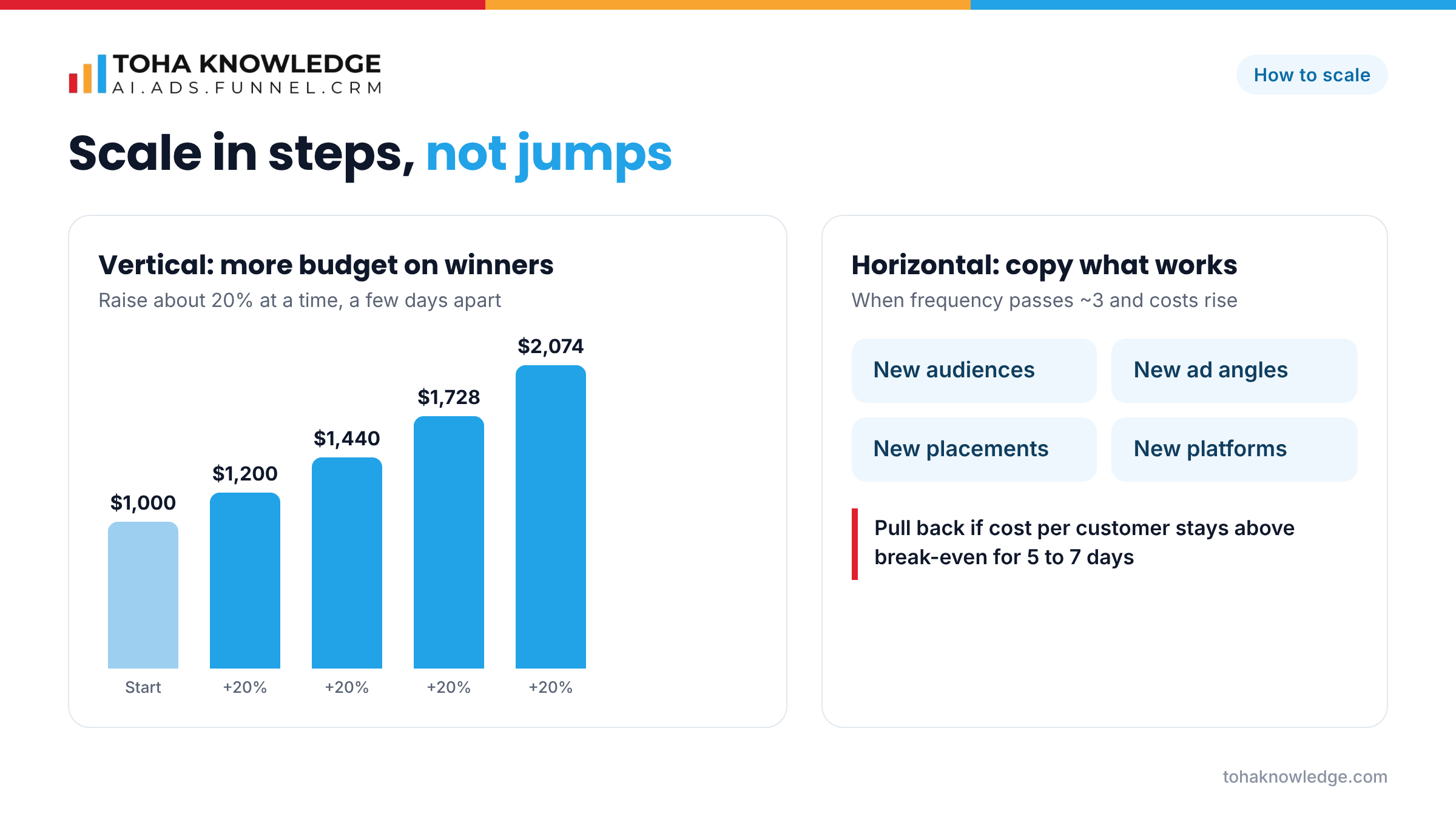
Raise budgets on winning campaigns in steps. Many media buyers raise budgets about 20% at a time and wait a few days between increases. That’s a practitioner rule of thumb, not an official platform number. Expect cost per result to rise a little after each step. If it doesn’t recover within 5–7 days, pull the budget back to the last level that worked.
Horizontal scaling: new audiences, creatives and channels
Copy what works into new audiences, new ad angles, new placements or a new platform. Go horizontal when your core audience shows signs of fatigue: the same people see your ad again and again (frequency above about 3 is a common warning sign), costs per 1,000 views rise, and click-through rates fall.
How to split your budget once you’re scaling
A common approach is 70/20/10: 70% on proven campaigns, 20% on promising ones and 10% on true experiments, rebalanced every quarter. On a small budget, skip the split and put everything behind your one or two best campaigns until they’re stable.
For your total marketing budget, the U.S. Small Business Administration has long suggested 7–8% of gross revenue for businesses under $5 million in sales with healthy margins. Treat that as a starting point, then let your break-even CPA decide how far to go.
Scaling stop signs: CPA climbs above break-even and stays there, frequency rises while results fall, or leads start waiting longer for a reply.
Don’t stop at the sale: the Keep stage
Most funnel guides end at the close. That leaves money on the table. In a 2014 Harvard Business Review article, Amy Gallo noted that acquiring a new customer can cost 5 to 25 times more than keeping an existing one, depending on the study and the industry. Treat it as a direction, not a forecast.
The practical point: every repeat job, review and referral lowers your real cost per customer, which raises how much you can afford to bid on ads. Add these to your funnel:
- An automatic review request after every completed job
- A check-in message at 30, 90 and 365 days
- A referral offer for happy customers
- A reactivation campaign for past customers in your CRM
What to measure at each stage
| Stage | Measure | Ignore |
| Attract | Reach, cost per 1,000 views (CPM), frequency, how many people watch past the first 3 seconds | Likes and comments on their own |
| Engage | Click-through rate, cost per landing page view, time on page | Total site traffic |
| Convert | Landing page conversion rate, cost per lead, cost per booked call, close rate, CPA | Cost per click on its own |
| Keep | Repeat rate, reviews, referrals, lifetime gross profit | One-time revenue only |
Find your leak: a five-minute diagnosis
Start at the top of the table and stop at the first row that matches. That’s the step to fix first.
| What you see | Likely cause | Fix |
| People scroll past your ads | Weak hook or wrong audience | Test 3–5 new opening lines and visuals |
| Clicks but few leads | Page doesn’t match the ad, too many choices, slow load | One page per offer, one call to action, faster page |
| Leads but few sales | Slow or no follow-up, unclear qualification | 5-minute response, written lead criteria, follow-up sequence |
| Sales but no profit | CPA above break-even, prices too low | Recheck margins and max CPA; raise prices or improve close rate |
| Results fall when budget rises | Scaled too fast or audience saturated | Smaller budget steps, new creatives, new audiences |
| One-time customers only | No Keep stage | Reviews, check-ins, referral offer, reactivation |
Which step are you on? Four common scenarios
| Your situation | What it usually means | Your next step |
| New business, no customers yet | You haven’t proven the offer converts | Build one offer and one landing page, then run a small ad test |
| Getting traffic but no leads | The page or the offer is the problem, not the ads | One offer, one call to action, a faster page that matches the ad |
| Getting leads but few sales | Follow-up or qualification is leaking | 5-minute response, written lead criteria, a follow-up sequence |
| Profitable and steady | You’ve earned the right to scale | Raise budget in ~20% steps, add fresh creatives, check your team can keep up |
Your 30-day test plan
- Before launch: install tracking (pixel, conversion events, CRM source tags), calculate break-even ROAS and max CPA, and build one dedicated landing page.
- Week 1: launch one campaign with 3–5 ad creatives. Don’t edit it for seven days, because significant edits restart learning.
- Week 2: pause the weakest creatives. Compare cost per lead and cost per booked call, not clicks.
- Week 3: run the leak diagnosis above and fix the first problem it finds, usually the page or the follow-up.
- Week 4: decide. CPA below break-even for 7+ days on enough sales to trust it means scale in small steps. Above break-even means fix the funnel. Far above with no improvement means rethink the offer. Too few sales to tell means keep testing.
Readiness scorecard
The first “no” is your next job.
| Question | If “no,” work on |
| Do I have one clear offer for one specific buyer? | Funnel |
| Does my landing page convert near my industry benchmark? | Funnel |
| Does every lead get an instant reply, and a call within 5 minutes during business hours? | Funnel (automation) |
| Can I trace every lead from ad to paid invoice? | Funnel (tracking) |
| Do I know my break-even ROAS and max CPA? | Ads (math) |
| Has CPA stayed below break-even for 7+ days, on enough sales to trust it? | Ads |
| Have my campaigns exited (or settled after) the learning phase? | Ads |
| Do I have fresh creatives ready to rotate in? | Scaling |
| Can my team handle twice the leads without slowing down? | Scaling |
| Do customers come back, review and refer? | Keep |
Where automation fits
The biggest leaks rarely sit in the ad. They sit in the minutes and days after a form is submitted: no instant reply, no second follow-up, no record of which campaign produced which sale, no review request after the job.
Automation closes every one of those gaps: instant replies, an AI assistant that answers and books around the clock, follow-up sequences, CRM tracking from click to invoice, and review and referral requests on autopilot. That’s what makes scaling safe, because more leads no longer means slower answers.
This is the work we do at Toha Knowledge. We cover the full chain, from conversion-focused landing pages and ad campaigns to the CRM and AI automation behind them, so your funnel, ads and scaling plan run as one system.
FAQ
Is a funnel more important than ads?
At the start, yes. A good funnel makes every ad dollar work harder. Once the funnel converts, ads become the lever that grows it.
Can I run ads without a funnel?
You can, but you’ll pay more per customer. Without a focused page and fast follow-up, paid traffic leaks away.
My ads aren’t working. Do I fix the funnel or the ads?
Use the leak table. If people click but don’t convert, fix the page or follow-up. If almost nobody clicks, fix the creative, offer or targeting.
How much should I spend to test ads?
On Meta, plan for your target cost per result × 50 per ad set each week so the platform can learn. Below that, run fewer ad sets and give results more time.
When your cost per customer has stayed below break-even for at least seven days, across enough sales to trust the number, and your team can handle more leads without slowing down.
How fast can I increase my ad budget?
Many buyers raise budgets about 20% at a time, a few days apart, watching CPA after each step.
What is the difference between vertical and horizontal scaling?
Vertical scaling adds budget to campaigns that already work. Horizontal scaling copies them into new audiences, creatives, placements or platforms.
What are the stages of a marketing funnel?
Models vary from three to five stages. This guide uses four: attract, engage, convert and keep.
Find your leak in one free call
Not sure whether your next dollar belongs in the funnel, the ads or scaling? Book a free strategy call with Toha Knowledge. We’ll run the leak diagnosis on your real numbers and show you the one step to fix first.
Book your free strategy call →