
Last checked: 2 november, 2026 ChatGPT changes often, so we re-test every quarter.
When a buyer asks ChatGPT “what is the best [your category] tool?”, your SaaS is either in the answer or it is not. Most founders only notice after a competitor starts showing up in demos and sales calls.
This post shows what we found when we ran buyer prompts through ChatGPT, what published studies say about who gets cited, and a 30-day plan you can run with a small team. We also say which claims are weak, because many guides on this topic skip that.
The short answer
ChatGPT cites pages and it recommends brands. These are different things, and a SaaS needs both. In one study of 278 buyer prompts, ChatGPT named brands in its text 552 times but cited those brands’ own domains only 375 times. The two overlapped just 185 times.
So the plan has three parts:
- Let ChatGPT’s search crawler reach your site.
- Publish pages that answer one buyer question clearly, so they are worth citing.
- Get named on the third-party pages ChatGPT already reads, such as “best X” lists, review sites and forums.
Most of the effort goes into part 3. Your own blog is only one piece.
Cited vs recommended: why “fix your site” advice falls short
Most guides tell you to optimize your own pages. That helps with one half of the problem.
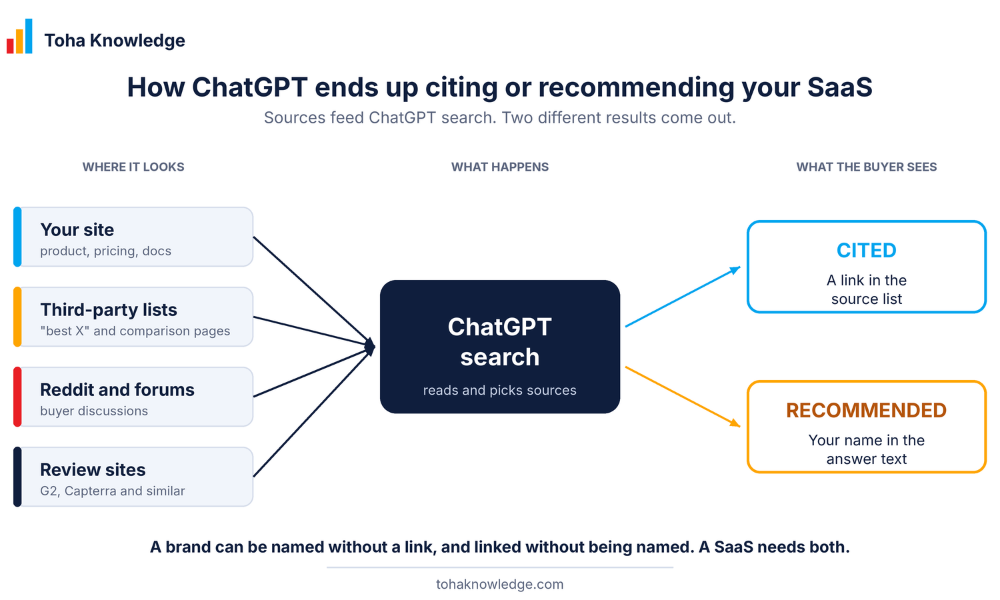
| Cited | Recommended | |
| What the reader sees | A link in the answer’s source list | Your brand name in the answer text |
| What it needs | A page ChatGPT can reach and finds useful | Mentions on pages and forums ChatGPT reads |
| Where it comes from | Often your own pages, docs or comparison pages | Mostly other sites: lists, reviews, discussions |
| Who controls it | You, mostly | You, only partly |
Position Digital’s study of 278 buyer prompts across six B2B SaaS categories found that most recommendations happened without a citation to the brand’s own site. It reports that 66% of recommendations had no link to the brand’s site. It also found that third-party “best of” list presence tracked brand mentions more closely (correlation 0.64) than having your own site cited (0.46).
DerivateX ran 40 SaaS categories with 10 runs each. When ChatGPT recommended a tool, it cited that tool’s own site 11.6% of the time. In 25 of the 40 categories, no vendor got an own-site citation at all.
These are small studies run by agencies, and they show correlation, not cause. But they agree on one thing: your own blog is rarely the main reason you get named.
What the studies say, and how far to trust them
There is little independent research on this yet. Most of what exists comes from agencies and tool vendors. We list the findings below with their limits, so you can judge them.
| Finding | Source | Limit |
| Brands were named 552 times but their domains cited 375 times, overlapping 185 times | Position Digital | 278 prompts, six categories, July 2026, US and UK |
| Third-party list presence correlated with mentions (0.64), branded web mentions (0.58), Reddit presence (0.57) | Position Digital | Correlation, not cause. Small brand samples |
| Listicles (18.8%), product pages (18.6%) and documentation (12.5%) held about half of citations | Position Digital | Same study |
| G2 review count correlated with mentions (0.39). G2 star rating did not (-0.07) | Position Digital | The study’s own table and text disagree on the pattern at high review counts |
| A tool’s own site was cited 11.6% of the time. Third parties got 88.4% | DerivateX | One prompt per category, 233 recommendations, some internal figures inconsistent |
| No vendor got an own-site citation in 25 of 40 categories | DerivateX | Same study |
Two cautions. First, both studies cover one AI engine at one point in time. Second, both are published by agencies that sell the services they recommend. We include their numbers because they are the best published data we found, not because they are final.
We also left out claims we could not support. Several popular guides promise results “in 30 days” or “two to three months”, or say a Lighthouse score above 90 or an llms.txt file will get you cited. We found no evidence for any of these.
Make Sure ChatGPT Can Access Your SaaS Website
Step 1: Let ChatGPT’s search crawler reach your site
This is the only step with official documentation, so start here. OpenAI’s bots page describes three separate bots:
- OAI-SearchBot surfaces sites in ChatGPT’s search features. OpenAI says sites opted out of it “will not be shown in ChatGPT search answers.”
- GPTBot is used for training. Blocking it does not control search visibility.
- ChatGPT-User handles visits a user triggers. OpenAI says robots.txt rules may not apply to it, and that it does not decide whether content appears in Search.
OpenAI states that each setting is independent. You can allow OAI-SearchBot and still block GPTBot if you do not want your content used for training.
User-agent: OAI-SearchBot
Allow: /
Check your robots.txt, your CDN and your firewall. Some security settings block unknown bots without telling you. OpenAI says a robots.txt change can take about 24 hours to take effect for search.
Step 2: Publish pages worth citing
In Position Digital’s data, listicles, product pages and documentation earned the most citations. For a SaaS, that points to four page types:
- Comparison pages (“[You] vs [competitor]”) that are honest about where each tool fits.
- Use-case and pricing pages that answer one buyer question each.
- Documentation that explains how things work in plain language.
- Your own category guide, if you are credible in the space.
For each page: put the answer in the first paragraph, use a real HTML table for comparisons, show a date, and name the people, products and standards involved. Position Digital found cited pages averaged about 10 named entities per 1,000 words, against 8 for uncited ranking pages. That is a small gap from a small study, so treat it as a hint and not a rule.
Step 3: Get onto the lists ChatGPT reads
This is where the studies point hardest. Third-party “best X” pages were the strongest signal for being named.
- Find them. Run your buyer prompts, open the sources, and list every third-party page that appears. Also search Google for “best [category] software” and note the top 10.
- Check what they need. Many list authors want a free trial, a clear feature summary and a contact for corrections.
- Pitch honestly. Send a short note with what is new, what you do better for a specific use case, and a trial link. Do not offer undisclosed payment for placement. It can break the site’s own rules and damages trust.
- Fix errors. If a list shows your old pricing or wrong features, ask for a correction.
Step 4: Be present where buyers talk
Brand mentions on the web and Reddit presence both tracked mentions in Position Digital’s study (0.58 and 0.57). That is correlation, but it fits how people choose software.
- Answer real questions in the communities your buyers use. Say who you are. Do not post links to your own product in every reply.
- Collect honest reviews on the sites in your category. In the same study, review count mattered more than star rating.
- Join comparison threads where your category is discussed, and be clear about your tie to the product.
Do not fake reviews or accounts. It breaks site rules and puts your brand at risk.
Step 5: Keep your facts consistent
ChatGPT builds its answer from many pages. If they disagree about your name, price or category, you can end up described wrongly or skipped.
- Use the same name, one-line description and category on your site, social profiles and listings.
- Keep pricing and feature pages current, and show an updated date.
- Fix old pages and old third-party mentions that show retired plans.
Step 6: Measure, and repeat
Re-run your prompt test every month. Keep the same prompts so you can compare.
| Metric | How to record it |
| Named in the answer | Yes or no, per prompt and run |
| Cited with a link | Yes or no, and which page |
| Position in the list | Number, if a list appears |
| Competitors named | List them |
| Cited page types | Listicle, vendor, docs, forum, news |
Paid trackers exist, but a spreadsheet is enough to start. Answers vary from run to run, so look at changes across many prompts and not one answer.
A 30-day plan
This is a plan to work through, not a promise of results.
| Week | Do this |
| 1 | Check robots.txt, CDN and firewall for OAI-SearchBot. Run your baseline prompt test. List the third-party pages that ChatGPT cites in your category |
| 2 | Fix or publish two pages: one comparison and one use-case or pricing page. Make your name, description and pricing consistent everywhere |
| 3 | Pitch five to ten of the third-party lists. Ask for corrections where you are described wrongly. Start honest participation in two communities |
| 4 | Re-run the prompt test. Record what changed. Plan month two from the gaps |
What we cannot promise
- Results vary by prompt, location and day.
- The studies we cite cover one engine, one month and small samples.
- Most numbers show correlation. We do not know that any single step causes a citation.
- ChatGPT’s behaviour can change, so re-test often.
FAQs
How long does it take to get cited?
No one can say reliably. Guides that promise 30 days or a quarter show no evidence. Expect to track progress monthly.
Do I need to allow OAI-SearchBot?
Yes, if you want to appear in ChatGPT search answers. OpenAI says opted-out sites will not be shown there.
Does blocking GPTBot stop me from appearing in ChatGPT?
No. OpenAI says the bots’ settings are independent. GPTBot relates to training, not search.
Do I need schema markup?
It is good practice for search, but we found no solid evidence that it changes ChatGPT citations. Do it for your pages’ other benefits.
Does llms.txt help?
We found no evidence that it does. If you add one, test it and do not expect results.
Can I pay to be cited?
Do not pay for hidden placements. If you sponsor content, it should be labelled. Paying a list author for an undisclosed mention can break the site’s rules.
Does ChatGPT use Google rankings?
One study found 58% of cited pages ranked in Google’s top 10. That shows a link, not a rule. Good SEO still helps.
The bottom line
To get cited in ChatGPT as a SaaS company, let OAI-SearchBot in, publish pages that answer one buyer question well, and get named on the third-party lists and forums ChatGPT already reads. Track it monthly. Treat any guide that promises a date as a sales pitch. [Add one sentence on what your own test showed.]
Want a baseline for your SaaS?
We run an AI visibility audit at Toha Knowledge: your buyer-prompt test, a crawl-access check and a short, prioritised fix list. Contact us to get started.